
Anti-Aging & Lifting
Korean Thread Lift or a Lifting Device? Threads Move Tissue, Devices Tighten It
A korean thread lift raises sagging tissue with absorbable threads. See who it suits, what can go wrong, and how to plan the trip to Yeouido, Seoul. A Korean…

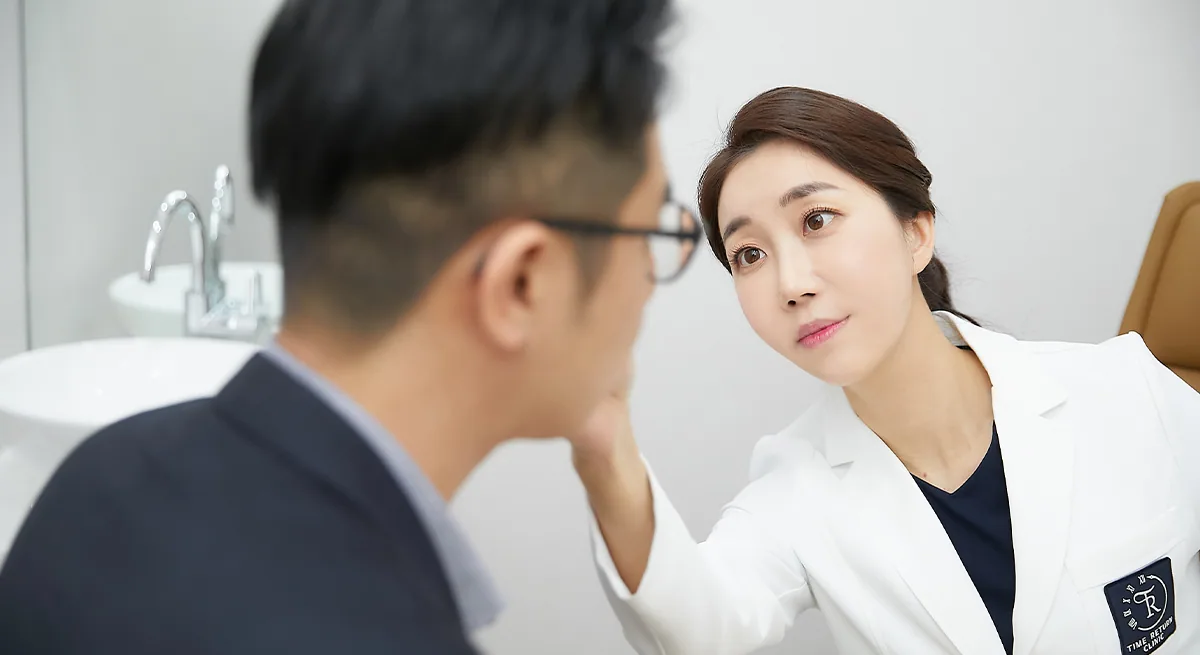
A korean thread lift is a non-surgical lift: a doctor places absorbable threads under the skin to pull sagging tissue back up and hold it there while the threads dissolve. It suits mild to moderate sagging along the jaw, cheeks, brows or neck, and it suits heavy, loose skin poorly. If you're fitting it into a short trip to Seoul, the usual worry is practical: will the swelling and the tight feeling settle before the flight home, and what happens if something feels off once you're back?
At Time Return Clinic in Yeouido, thread lifting uses a collagen-film method that is patented in Korea (registered Mar 2, 2021), and lifting has its own Lifting Center inside the clinic.
If you already know which area bothers you, send that one line and your travel dates on WhatsApp. The clinic replies with available consultation times, so you can see whether an assessment fits your trip before you book flights.
Which lift fits what you see in the mirror
Start with the problem, then the tool. Threads reposition tissue that has moved; energy devices tighten tissue that has loosened in place; skin boosters work on the quality of the skin itself.
| What you notice | What usually addresses it | Option at this clinic |
|---|---|---|
| Jawline and cheeks have dropped | Threads that lift and anchor tissue | Patented thread lifting |
| Brows, eye area, frown lines or neck | Threads in one small area | Edge lifting |
| Skin feels lax but hasn't moved much | Ultrasound or radiofrequency tightening | Ultherapy Prime or Thermage FLX |
| Thin, crepey skin and fine lines | Skin-quality treatment | Rejuran Healer |
| Laxity on the body | Body threads | Body Ssok lifting |
Most faces fit more than one row. A forty-something face often has a dropped jawline and thinning skin at the same time, and the order of treatment changes what you see. Here the doctor sets that order after looking at your skin, and there is no fixed package to pick from a menu.
How does a Korean thread lift actually lift the face?
Each thread carries small barbs or cones that grip the soft tissue under the skin. The doctor passes it in through a fine needle or cannula along a planned line, lifts the tissue along that line and anchors it, usually under local anesthesia.
The American Society of Plastic Surgeons describes a thread lift as a less invasive alternative to a facelift, with more modest and shorter-lived results. No skin is cut away. That one fact explains most of what threads can and cannot do.
Two things happen over the following months. The threads slowly absorb, and the body lays down collagen along their path, which is thought to be why the lift tends to fade gradually instead of dropping at once. The threads used here add collagen film, a method registered as a patent in Korea; the certificates are shown on the thread lifting page.
Who a thread lift suits, and who it doesn't
Threads suit early to moderate sagging with enough soft tissue for the barbs to hold: a softening jawline, flattened cheeks, a heavier brow. They suit poorly when excess skin is the main issue, when the skin is very thin, or when lower-face heaviness comes mostly from fat.
The traits a doctor weighs are concrete:
- How much skin is loose. Threads hold tissue up; they can't remove extra skin.
- Skin thickness. Very thin skin can show a thread line or a small dimple more easily.
- Fat in the lower face. Heavy jowls from fat volume pull against the threads.
- What's already there. Filler or old threads in the same layer change how new threads are placed.
- Your tolerance for a few tender days. Chewing, yawning and sleeping on your side can feel tight at first.
Doctor's note
The face I find hardest to thread is one with a lot of loose skin and a wish for a facelift result. Threads can lift that face for a while, but the skin is still there, and the result can disappoint quickly. In that situation a surgical consultation is the more useful conversation, and I would rather say so than place threads.
What are the risks and side effects of a thread lift?
Bruising, swelling and tenderness are the common effects, and they usually settle on their own. Less often, people notice dimpling or puckering, a thread that can be felt or seen, asymmetry, or a thread end working toward the surface. Infection and nerve irritation are uncommon but possible.
That list comes from the ASPS thread lift safety page. A discussion of a meta-analysis on facial threadlifting in Aesthetic Plastic Surgery (2021) adds that most reported complications were minor and temporary, while noting the limits of the published data.
Thread lifting is usually postponed or reconsidered if you have an active skin infection in the area, a bleeding tendency, or are pregnant. Tell the doctor about any blood thinners and supplements you take, and about every filler or thread treatment you've had, with dates if you have them.
Results vary from person to person, and whether threads are right for your face is decided at the in-person exam.
How long should a Seoul trip for a thread lift be?
The clinic doesn't publish a fixed number of days, so plan the consultation and treatment early in the trip and leave a buffer before the flight. Bruising and swelling are most visible in the first days, which is the part you want to spend in Seoul.
The U.S. CDC's medical tourism guidance gives the same advice for any procedure abroad: allow time to recover before flying, take copies of your records home, and arrange follow-up care in your home country before you leave.
The practical details that shape the plan:
- Getting there. Line 9 runs from Gimpo Airport to Yeouido Station; the clinic is about 4 minutes on foot from Exit 4.
- Hours. Mon–Fri 10:00–20:00, Sat 10:00–16:00, closed Sundays and public holidays. Land on a Saturday evening and Monday morning is the next opening.
- What to carry home. A note of which threads were placed and where, for any doctor who sees you later.
Doctor's note
If a friend asked me how to plan this, I'd tell them to put the consultation on the first working day of the trip and the flight as late as their leave allows. Every extra day in Seoul is a day when a small question about swelling can still be answered in person.
Send your flight-in and flight-out dates on WhatsApp, with the area you want lifted. The clinic replies with consultation times that fit those dates, and you can see how many days are left between treatment and departure.
Face, small areas or body: which thread lift are you asking about?
Three different procedures sit under the word "thread lift" here. Knowing which one you mean makes the first message shorter.
- Patented thread lifting works on the face and body contour with the collagen-film threads described above.
- Edge lifting focuses on small areas such as the brows, eye area, frown lines and neck instead of the whole face contour.
- Body Ssok lifting is patented body thread lifting for firmness on the body.
Pairing threads with Rejuran or a device
Threads and skin boosters can be planned together, and so can threads and energy devices. The doctor chooses the combination after your assessment.
The logic is a sequence: Rejuran rebuilds skin quality, lifting restores shape, laser evens tone. TR Ulthera lifting already mixes Ulthera, Thermage and Rejuran in one plan for people who want firmness and skin quality together. If your skin is thin as well as sagging, it's worth reading why Rejuran results differ by doctor before you decide what to pair.
Who plans and performs the lift
The doctors who plan your treatment also perform it. I hold the patent for collagen-film thread lifting, along with a body thread lifting patent, and I'm a key doctor for TAPS, Quill and Aprodemion thread lifting. Our Lifting Center is directed by Dr. Kim Dong-hu, a family medicine specialist.
The first conversation is with the director in person. Credentials for both doctors are on the doctors page, and the location page has the map from Yeouido Station.
To start, send a front photo and a side photo of the area you'd like lifted, plus your travel dates, on WhatsApp. The clinic replies with available times for those dates and what to prepare before your visit, so you know whether the trip works before you book it.
Questions we get about korean thread lift
Is a thread lift the same as a facelift?
How long does a thread lift last?
Does a thread lift hurt?
Can I have a thread lift if I already have filler?
What should I bring to a thread lift consultation in Seoul?
Results vary by individual. Every procedure carries the possibility of side effects, explained before you agree to treatment. This article is general information from the clinic, not a diagnosis. Suitability is decided at the consultation.
Written by
Dr. Kim Yoo-ju
Founder & Medical Director · Time Return Clinic
- Patent holder: collagen-film thread lifting; also holds Korea’s only body thread lifting patent
- Rejuran clinical advisor and Rejuran Expert
- Thermage clinical advisor and TTT Master
Related articles
Anti-Aging & Lifting
Threads Hold, Ultrasound Tightens: Choosing a Korean Lift and Knowing When to Skip It
A Korean lift can mean threads, Ultherapy Prime or Thermage FLX. What each can and can't do, the real risks, and which faces are better off skipping it.
· 7 min read
Anti-Aging & Lifting
Should You Get Korean Filler on a Short Trip? Here's When to Wait
Thinking about korean filler in Seoul? Learn the real risks, five situations where waiting is wiser, and how many days to leave before your flight home.
· 8 min read
Skin Treatments
Fat Dissolving Injections Korea: Who They Suit and What to Plan
Fat dissolving injections korea guide from Time Return Clinic in Seoul: what they do, who they suit, risks and how to plan a short trip. Message us to plan.
· 5 min read
Ready to plan your Rejuran visit?
Send your skin concern and dates. The clinic replies with available times.
Message us your plan